

Spangle Budgerigar
In 1971, Mr. Sergio Casagrande of Reservoir, Victoria, first notices a new variety in his aviary. The following year, Budgerigar Council of Australasia (B.C.A.) Secretary Mr. Harry Eady observes the same birds. Meanwhile, Mr. Merv Jones of Traralgon, Victoria, begins establishing the mutation now known as the Spangle Budgerigar.
In 1974, Mr. Jones breeds the first Spangle from a single bird purchased from his neighbour, Albert Richie. Within two years, he successfully breeds sixty similar birds. Clear yellow or white birds also begin appearing. People refer to these lighter-coloured birds as Double Factor Spangle budgies due to their distinctive appearance.
Curious, Mr. Jones seeks advice from leading Victorian breeder Mr. Frank Gardner, believing he has discovered something unique. In 1976, six unusual birds are brought to the Gardner Shield Show for Mr. Gardner to examine. After inspection, Mr. Gardner confirms that they represent a new mutation in the budgerigar world. At the time, fanciers use the term “spangley” to describe their unusual markings.
Drawing inspiration from poultry, Mr. Gardner names the variety “Spangle” due to the similarity in feather patterns. Recognition that the clear yellow and white birds share the same mutation is credited to Mr. Geoff Gardiner. Notably, Geoff is a young breeder at the time and should not be confused with Frank Gardner.
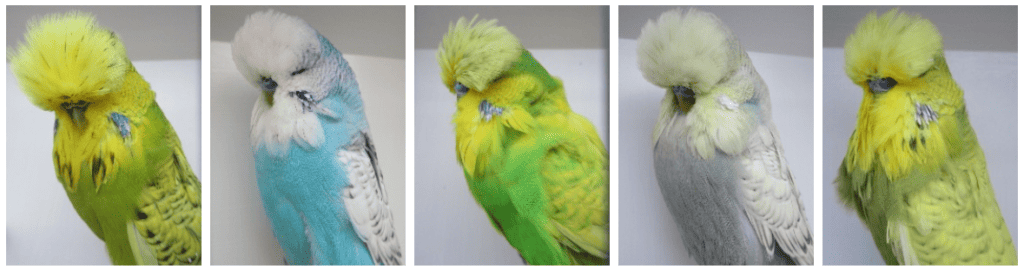
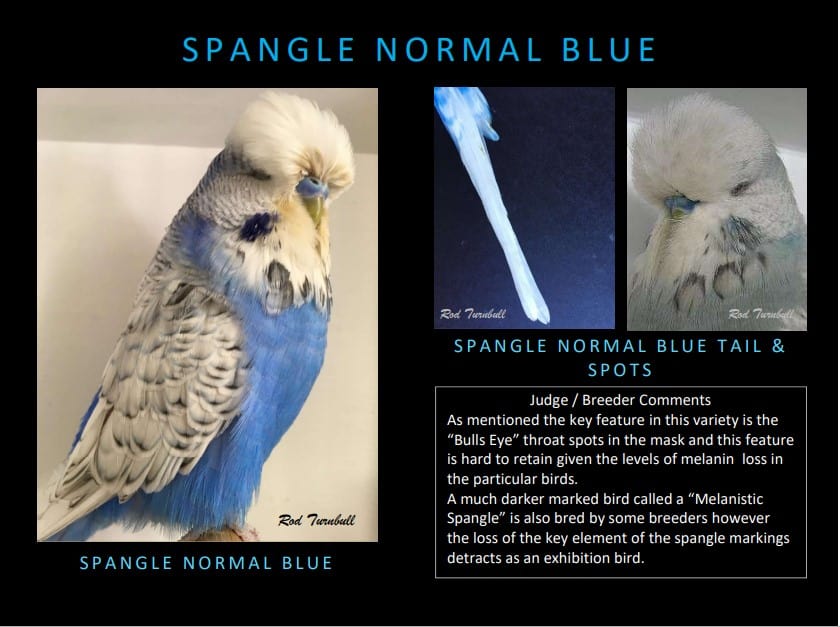
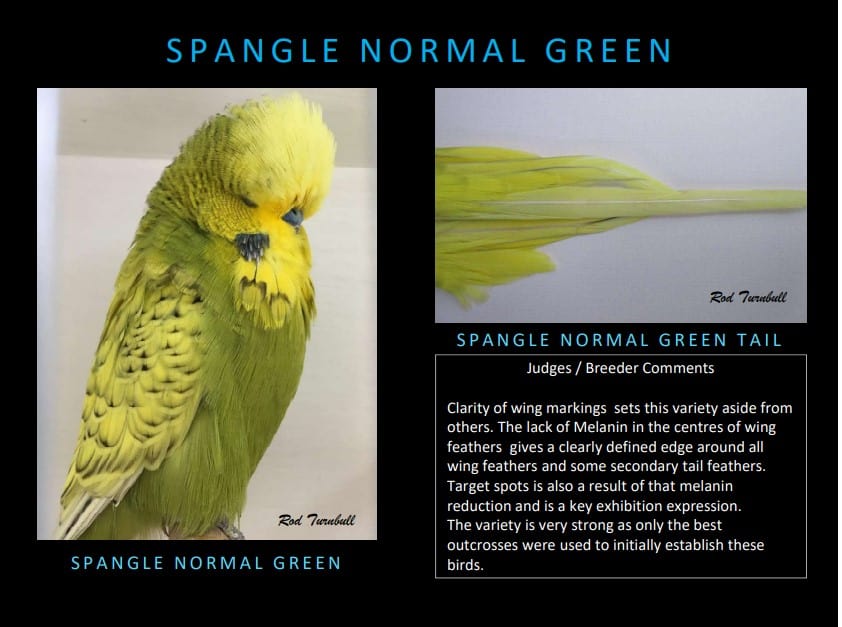
Image Courtesy of Rod Turnbull and the ANBC
Identification of The Exhibition Spangle Budgie
When selecting a budgie, pay close attention to the mask and spots on the face, which should be clear, wide, and deep, with six evenly spaced black throat spots with a ground colour centre. The back, rump, breast, flanks, and underparts of the bird should be a solid and even shade throughout. Look for markings on the cheeks, back of the head, neck, and wings that are black, clearly defined, and symmetrical on the appropriate ground colour. The eyes should be black with a white iris ring, and the body colour should be at full intensity. Lastly, the feet and legs should be blue/grey. By following these guidelines, you’ll be sure to select a stunning budgerigar that meets The Standard for this variety. With this in mind, wing markings are critical in this variety, given it is the key component to the varietal features.
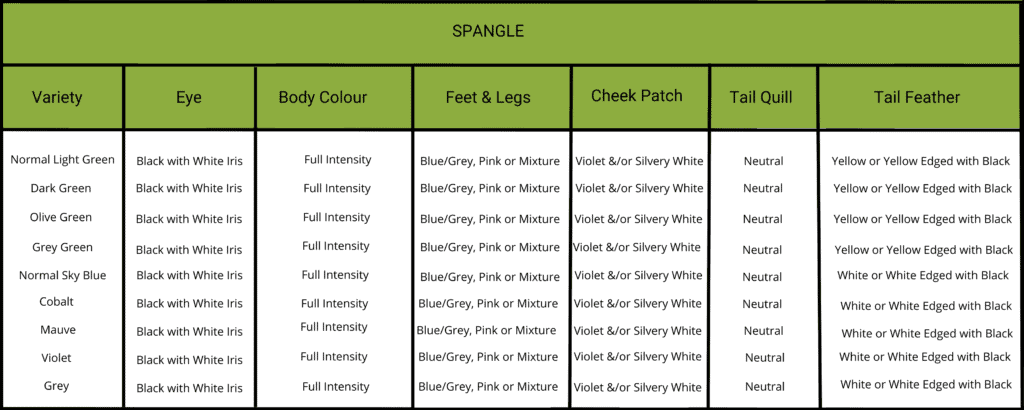
Below is a summary of the colors of the Spangle budgerigar’s cheek patch, tail quill, and tail feathers.
Varietal Features
How They Present
Spangle AOSV and Normal wing Spangles are divided into two distinct classes to protect the Normal wing well-defined fine black marking near the wing covert’s edge. This black marking gives the variety its unique name. The melanin close to the wing covert edge is significant, but the budgie’s size, type, and associated markings like target spots are important. To that end, Normal Spangle hens tend to exhibit more melanin than cocks.
The Spangle AOSV class frequently has Cinnamonwing, Opaline, and Opaline Cinnamonwing variants entered. The ideal presentation includes target spots and the removal of unnecessary crescent-shaped flecks from the mask to emphasize the three main spots on either side. This creates a stunning visual effect. Learning about the intricate details of the Spangle budgie helps bird enthusiasts recognise and appreciate the various types and their characteristics.
Distinction between Normal & Opaline Variants
Identifying the differences between various Spangles like Normal wing Spangle cocks and Spangle Opalines can generally be straightforward but sometimes challenging due to poor variety. This difficulty is particularly common when assessing Normal wing Spangle cocks that are split for Opaline. Both bird enthusiasts and judges must be aware, as exhibitors may mistakenly place Spangles in the wrong class. To properly categorize and evaluate these, consider these four critical areas:
- Firstly, the back of head. Indeed, a point often overlooked is that normal Spangles are known for dense striations on the back of the head. However, faults like opalescence or body color intrusion can make Normal wing Spangles less distinct.
- Secondly, the mantle. Body color in the mantle often identifies Opaline, but an intrusion of body color into Normal wing Spangles may cause confusion.
- Thirdly, wings. Although body color in the wings often indicates Opaline, body color may also appear in Normal wing variant. Spangle Opalines may present beautiful marbled effects without black markings, but wing markings must still be present.
- Finally, the rump. Above all, a distinguishing feature is that normal wing Spangles, and Cinnamon wing variants, show mottling on the rump, contrasting with Opalines’ form, which has full color in the same area. The extent of the ground color patches vary, especially in cocks that are split for Opaline.
By understanding these specific characteristics and potential variations, bird keepers, judges, and enthusiasts can make accurate visual distinctions between variants, improving classification and appreciation of these unique budgies.
Melanistic
Nest feather wing markings in melanistic birds are akin to Normal variants of budgies. However, these birds are distinguishable by a clear yellow or white tail. Upon moulting, the bird transitions into a recognizable Spangle. These specific variants are characterized by retaining full black spots, unbroken violet or grey cheek patches, and strong, uniform body color. Such attributes indicate that this variant may carry more melanin than the original Spangle mutation. Bird enthusiasts and breeders looking to understand this Spangle variant can refer to the work of the ANBC (Australian National Budgerigar Council), which has formed a Working Party to enhance understanding and appreciation of these Spangle features.
Suggested Pairings to Produce
Emphatically, this variety is east to reproduce, as it is dominant. Pairing a Spangle budgie to a good quality normal is the best option for this reason. What’s more, pairing Spangles to one another can produce double factors.
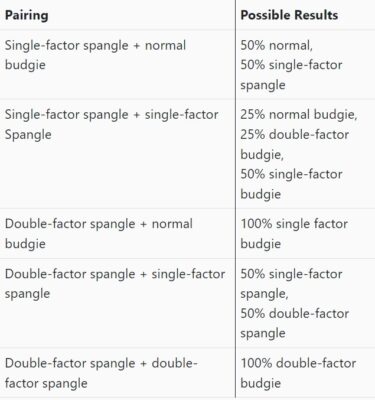
Click here to view pairing chart in full.
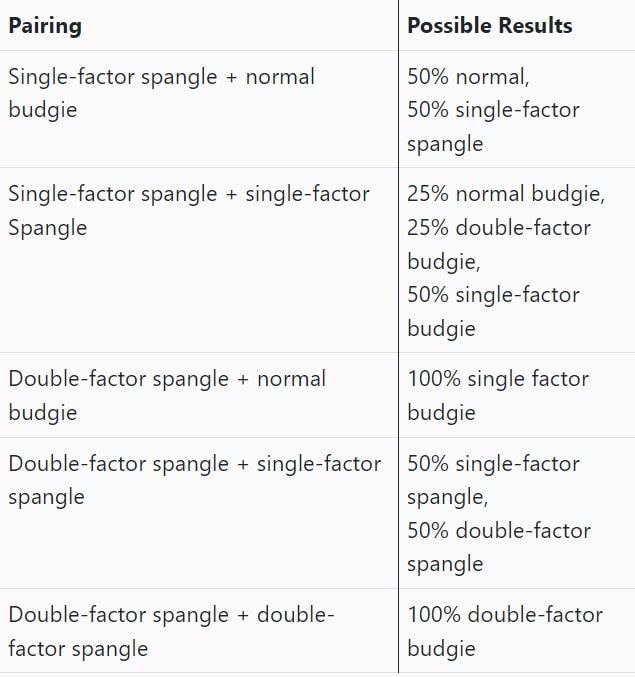
For all the latest information on varieties, be sure to follow our socials.